Regional government officials claim that the image of the Valencia region of Spain projected in foreign documentaries is unreal.
Read more: Splash out then watch the crash | In English | EL PAÍS
Showing posts with label Economy. Show all posts
Showing posts with label Economy. Show all posts
Tuesday, 8 January 2013


Saturday, 1 September 2012
VAT rates increase in Spain.
As part of the austerity package needed
to bring the Spanish economy and debt under control the government
has increased the rates of VAT charged on goods and services with
effect from the 1st September 2012.
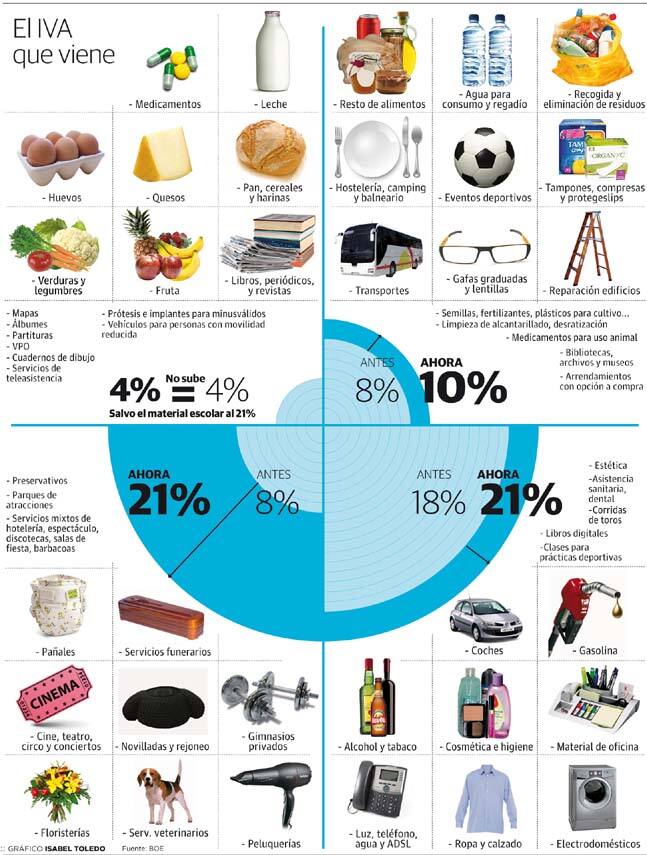
Prior to this date Spain had three
rates of VAT, 4%, 8% and 18% with the various category of goods and
services subject to one of these rates.
 |
| Graphic by Laverdad.es http://www.laverdad.es/RC/201208/31/Media/iva1.jpg |
From the 1st September the 8% rate has
been increased by 2 points to 10% and the 18% rate has been increased
by a greater amount to 21%. the lowest rate of 4% on essential goods
has not been increased although some items charged at this rate have
been reclassified to a higher rate group.
In the case of school supplies;
textbooks, albums, sheet music, maps and sketchbooks, remain taxed at
super reduced VAT of 4%; whilst pens, diaries, cards, craft pads,
compasses, colored paper and plasticine and similar items are now
classed as office supplies and are subject to a 17% increase in VAT
to 21%.
There has also been a recatagorisation
of items in the middle rate to the top rate, an increase from 8% to
21%. These include entry to theaters, cinemas, circuses and other
shows and some services, such as hairdressing and funeral services.
The same goes for some cosmetics and personal care products.
The increases in the rates are the
greatest rise in VAT rates in the history of Spain and are viewed
with suspicion by many sectors of the economy. The Consumers and
Users Organization has estimated the increase for consumers at 470
euros per year.
The Prime Minister gave his assurances that if Spain continues on this path it will begin to regain confidence as a country, showing that it is "serious and dutiful", enabling cheaper financing and attract investment to return rapidly to grow and create jobs.
It is very easy for him to offer this long term hypothesis as justification for the increases in VAT but it is the unemployed, the low income workers and the pensioners who will be those who suffer the most in the present time. They will suffer because of the failings of the monied elite.
How much closer will the state of the Spanish economy get to that of Greece? How much longer will it be before the citizens of Spain escalate their demonstrations against the policies of the rightwing Partido Popular government led by Mariano Rajoy?
http://www.europapress.es/economia/noticia-hoy-entra-vigor-subida-iva-20120901081120.html
http://www.laverdad.es/alicante/rc/20120901/economia/vivir-desde-manana-caro-201208310051.html
http://www.europapress.es/nacional/noticia-rajoy-reconoce-subida-iva-dolorosa-no-caera-saco-roto-20120901141901.html
Update: 28.09.2012
VAT increase causes inflation to jump to 3.5 percent in September.
Wednesday, 14 December 2011
The Spanish are poorer!
According to an article by El Pais the Spanish paper "It appears that the per capita income of Spaniards has gone on declining in 2010 in relation to its previous levels; but also, and even more worryingly, with respect to the European average. In 2010, according to the Eurostat data released on Tuesday, it stood eight points below the average of the 17 countries of the euro zone and exactly equal to the average of the 27 EU states".
Read the full article: The Spanish are poorer · ELPAÍS.com in English
Read the full article: The Spanish are poorer · ELPAÍS.com in English
Wednesday, 22 December 2010
Prime Minister Zapatero says Spain will take five years to correct imbalances
During his appearance in the Congress to report about the last EU summit, the Prime Minister, José Zapatero, has said that Spain will need five years to correct structural imbalances in the economy.
In his view, the task of correcting these imbalances will not be just for the government but it will be a joint effort which requires adopting a perspective that allows to join efforts and reach agreements. The future must see a series of reforms, efforts, productivity and covenants. He said "it should be a time of vision, scope, responsibility and ability to drive and commitment even though it is unpopular. And of course we are willing to do that".
Read more: Zapatero dice que España tardará cinco años en corregir los desequilibrios. europapress.es
In his view, the task of correcting these imbalances will not be just for the government but it will be a joint effort which requires adopting a perspective that allows to join efforts and reach agreements. The future must see a series of reforms, efforts, productivity and covenants. He said "it should be a time of vision, scope, responsibility and ability to drive and commitment even though it is unpopular. And of course we are willing to do that".
Read more: Zapatero dice que España tardará cinco años en corregir los desequilibrios. europapress.es
Wednesday, 16 June 2010
Spanish unions call general strike over labour reforms
Spanish unions have called a general strike in response to labour market reforms due to be unveiled by the government on Wednesday.
The unions announced the strike would take place on 29 September, to coincide with a European "day of action".
Is this really going to help Spain at this time. The IMF report said that Spain needed a more flexible and competitive labour market.
Spanish unions call general strike over labour reforms
The unions announced the strike would take place on 29 September, to coincide with a European "day of action".
Is this really going to help Spain at this time. The IMF report said that Spain needed a more flexible and competitive labour market.
Spanish unions call general strike over labour reforms
Saturday, 29 May 2010
Monday, 24 May 2010
The International Monetary Fund has expressed fresh concerns about Spains ecomony,
The International Monetary Fund has expressed fresh concerns about Spains ecomony, saying that it (the ecomomy)
The IMF notes that an ambitious fiscal consolidation is underway to reach the three percent of GDP deficit target by 2013. To achieve the 10 percent improvement of the GDP from 2009 to 2013, the Spanish government has taken a wide range of measures, including the fiscal package approved by the Cabinet last week. The IMF supports the package.
Spain faces strong spending pressures over the longer term due to aging and slower population growth, therefore bold pension reforms should also be implemented soon. The IMF notes that the government has outlined possible reforms, including raising the retirement age to 67.
It is reported that the banking sector is sound but remains under pressure, with a need to accelerate a programme of consolidation and reform to reduce overcapacity and produce more robust institutions.
The full IMF mission statement can be read here.
"needs far-reaching and comprehensive reforms The challenges are severe: a dysfunctional labor market, the deflating property bubble, a large fiscal deficit, heavy private sector and external indebtedness, anemic productivity growth, weak competitiveness, and a banking sector with pockets of weakness"The IMF sees an outlook of a weak and fragile recovery which the policy agenda being based on rebalancing the economy and boosting confidence. The point is made that a radical overhaul of the labor market is urgently needed as it is not working with an excessively high umemployment figure.
The IMF notes that an ambitious fiscal consolidation is underway to reach the three percent of GDP deficit target by 2013. To achieve the 10 percent improvement of the GDP from 2009 to 2013, the Spanish government has taken a wide range of measures, including the fiscal package approved by the Cabinet last week. The IMF supports the package.
Spain faces strong spending pressures over the longer term due to aging and slower population growth, therefore bold pension reforms should also be implemented soon. The IMF notes that the government has outlined possible reforms, including raising the retirement age to 67.
It is reported that the banking sector is sound but remains under pressure, with a need to accelerate a programme of consolidation and reform to reduce overcapacity and produce more robust institutions.
The full IMF mission statement can be read here.
Subscribe to:
Posts (Atom)